
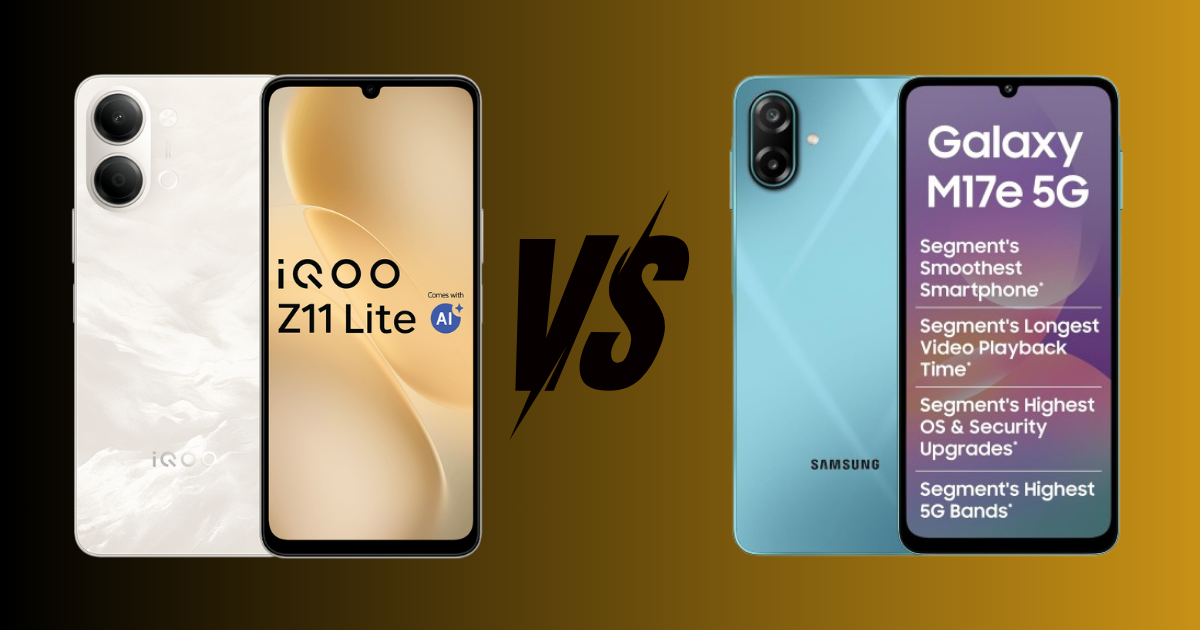
If you’re comparing iQOO Z11 Lite vs Samsung Galaxy M17e, you’re likely shopping in the sub-₹20,000 segment where every rupee matters.
Both phones chase the same buyer someone who wants a reliable 5G phone with a big battery and a smooth display, without overspending.
But they take different paths to get there. This guide breaks the decision down by actual use-case, not a spec-sheet dump, so you can figure out which one suits how you actually use your phone.
Table of Contents
Quick Comparison: iQOO Z11 Lite vs Samsung Galaxy M17e at a Glance
Here’s the short version before we go deeper.
Both phones actually share the same MediaTek Dimensity 6300 chipset. That alone tells you performance won’t be the deciding factor here.
Where they differ is battery size, charging speed, software support, and price. Samsung leans on a much longer update promise. iQOO leans on a bigger, faster-charging battery.
iQOO Z11 Lite vs Samsung Galaxy M17e: Price and Value
This is where the gap is biggest.
The Samsung Galaxy M17e 5G starts at ₹13,999 for the 4GB+128GB variant, with a 6GB+128GB option at ₹15,999.
The iQOO Z11 Lite 5G starts higher, at ₹19,499 for 4GB+128GB (effective ₹17,999 with bank offers), going up to ₹24,499 (effective ₹22,999) for the top 256GB variant.
That’s a real difference of roughly ₹4,000 to ₹6,000 depending on which variants you compare.
If budget is your primary filter in the iQOO Z11 Lite vs Galaxy M17e 5G decision, the Galaxy M17e 5G is simply the cheaper phone at every comparable tier.
| Variant | Samsung Galaxy M17e 5G | iQOO Z11 Lite 5G |
| 4GB + 128GB | ₹13,999 | ₹19,499 |
| 6GB + 128GB | ₹15,999 | ₹21,499 |
| 6GB + 256GB | – | ₹24,499 |
iQOO Z11 Lite vs Samsung Galaxy M17e: Display Comparison
Both phones use a similar-sized LCD panel with a 120Hz refresh rate, and interestingly, both share the same 1600×720 HD+ resolution so on paper, sharpness is nearly identical.
The iQOO Z11 Lite 5G claims a higher peak brightness of up to 1,200 nits, marketed as the brightest display in its segment, which should help outdoors under direct sunlight.
The Samsung Galaxy M17e 5G’s 6.7-inch PLS LCD panel is rated for up to 800 nits of peak brightness, which is respectable for this price bracket but noticeably lower than the Z11 Lite’s claimed figure, so the iQOO has a real edge for outdoor visibility under harsh sunlight.
Neither phone uses AMOLED here, so don’t expect the deep blacks or punchy colours you’d get from Samsung’s own M17 5G (a different, pricier model). For this specific comparison, display quality is close enough on resolution and refresh rate that it shouldn’t be your sole deciding factor but if you’re frequently outdoors, the brightness gap is worth weighing.
iQOO Z11 Lite vs Samsung Galaxy M17e: Performance and Gaming
Here’s the interesting part: both the iQOO Z11 Lite 5G and the Samsung Galaxy M17e 5G run the exact same MediaTek Dimensity 6300 chipset.
That means day-to-day performance app switching, browsing, social media, casual gaming should feel nearly identical between the two.
iQOO does claim an AnTuTu score above 579,000 for the Z11 Lite but with identical silicon, real-world gaming performance is unlikely to differ meaningfully.
If gaming is your priority, RAM matters more here than chipset. The Z11 Lite tops out at 6GB RAM with up to 256GB storage, while the M17e 5G tops out at 6GB RAM with 128GB storage. Multitasking headroom is essentially a tie, with a slight edge to the Z11 Lite’s higher-storage variant.
iQOO Z11 Lite vs Samsung Galaxy M17e: Camera Comparison
- iQOO Z11 Lite 5G: 50MP Sony primary sensor + 0.08MP secondary sensor, 5MP front camera.
- Samsung Galaxy M17e 5G: 50MP main camera + 2MP depth sensor, 8MP front camera.
Both phones keep cameras basic at this price point neither has an ultra-wide lens or OIS.
The Samsung Galaxy M17e 5G’s 8MP front camera is a meaningful step up over the iQOO Z11 Lite’s 5MP shooter, so if selfies and video calls matter more to you than the rear camera setup, Samsung has the edge here.
For rear camera photo quality in daylight, both should perform similarly given their comparable 50MP primary sensors, though low-light performance will depend on sensor size and processing details neither brand fully discloses at this tier
iQOO Z11 Lite vs Samsung Galaxy M17e: Battery and Charging
- iQOO Z11 Lite 5G: 6,500mAh battery, 44W wired charging, plus a claimed 5-year battery health promise (80% capacity retention).
- Samsung Galaxy M17e 5G: 6,000mAh battery, 25W wired charging, rated for up to 26 hours of continuous video playback.
Both phones prioritise battery life, but the iQOO Z11 Lite pulls ahead on two fronts: a larger cell and significantly faster charging. 44W versus 25W is a real difference in how long you’re tethered to a charger.
iQOO’s added longevity claim retaining 80% health after years of use is also worth factoring in if you tend to keep phones for 3+ years, since battery degradation is usually what makes a budget phone start to feel unreliable over time.
For anyone prioritising battery in the iQOO Z11 Lite vs Samsung Galaxy M17e 5G decision, the Z11 Lite is the stronger pick.
iQOO Z11 Lite vs Samsung Galaxy M17e: Software and Long-Term Updates
This is where Samsung pulls decisively ahead.
The Samsung Galaxy M17e 5G ships with Android 16 and One UI 8, backed by 6 major OS updates and 6 years of security patches an unusually strong commitment for a phone priced under ₹15,000.
The iQOO Z11 Lite 5G runs OriginOS 6, with 2 years of OS updates and 4 years of security patches.
If you plan to hold onto your phone for several years, this gap matters more than almost any other spec on this page. Samsung’s update window means the M17e 5G is far more likely to still feel current and stay secure three or four years down the line.
iQOO Z11 Lite vs Samsung Galaxy M17e: Build, Design and Durability
The iQOO Z11 Lite 5G carries a military-grade durability claim and SGS 5-Star Drop Resistance certification, along with a “Dynamic Light” ring around its camera module that glows for calls and notifications. Its official IP dust/water rating isn’t clearly published in available specs.
The Samsung Galaxy M17e 5G carries a confirmed IP54 rating (basic dust and splash resistance), a Glass Fibre Reinforced Polymer back panel, and measures 8.2mm thick.
Neither phone supports NFC, so if contactless/tap-to-pay is important to you, that’s a shared limitation on both sides of this comparison.
Final Verdict: iQOO Z11 Lite vs Galaxy M17e — Which One Should You Buy
Best for battery life and fast charging: iQOO Z11 Lite 5G bigger cell, 44W charging, and a stronger long-term battery health claim.
Best for budget buyers: Samsung Galaxy M17e 5G cheaper across every variant by ₹4,000 or more.
Best for long-term software support: Samsung Galaxy M17e 5G 6 years of updates versus 2 years on the Z11 Lite is a significant gap.
Best for gaming and everyday performance: Tie both run the same Dimensity 6300 chipset, so expect near-identical day-to-day speed.
Best for selfies and video calls: Galaxy M17e 5G its 8MP front camera outclasses the Z11 Lite’s 5MP shooter.
If you want the cheapest phone with the longest software runway, go with the Samsung Galaxy M17e 5G. If a bigger, faster-charging battery matters more to your daily routine than saving a few thousand rupees upfront, the iQOO Z11 Lite 5G is the better fit.
Pricing and specifications are based on information available as of July 2026 and may change with future price revisions. Figures marked should be confirmed against official brand spec pages before publishing.